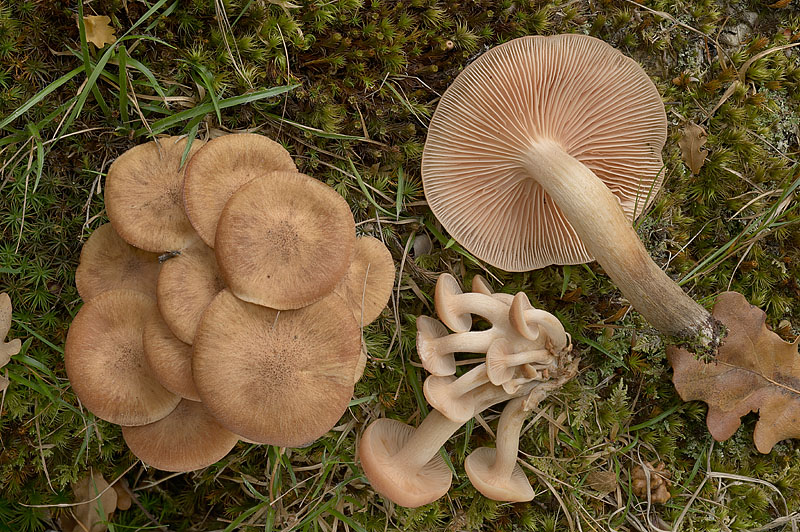
14 October 2025 Near Brockenhurst, New Forest, Hampshire. Photograph copyright Leif Goodwin. Cap Initially convex, becoming flattened to funnel shaped with a central bump, surface tawny brown, cinnamon brown or yellow brown, covered with fine scales, margin sometimes lined, sometimes pale, to about 6 cm across Gills Adnate to slightly decurrent, flesh coloured, then pinkish brown Stem Tapering to the apex, whitish when young, then pale brown at the apex, darker brown towards the base, ring absent Flesh Whitish, thin, brittle Smell Strong Taste Astringent to mild Season Summer to early autumn Distribution Infrequent Habitat At the base of living and dead deciduous trees, especially oak Spore Print Pale cream Microscopic Features Spores ellipsoidal, apiculus prominant, smooth (6-9) x (4-5) µm2. Basidia 2 and 4 spored. Cystidia absent. Edibility Edible when cooked Notes This species is very similar to other Armillaria species, but it is readily distinguished by the lack of a ring 
Spores in Congo Red solution viewed with a 100X immersion objective. 14 October 2025 Near Brockenhurst, New Forest, Hampshire. Photograph copyright Leif Goodwin. |